The Savings Training Plan: What Competitive Swimming Taught Me About Financial Independence

I swam competitively from age nine through college. Four AM practices. Shoulder pain that became background noise. Two years of work to shave 1.3 seconds off a 100-meter freestyle.
You know what nobody tells you about competitive swimming? The goal was never to want it more than the other girl in the next lane. It was to build systems so solid that wanting didn't even enter the equation.
That's what I keep thinking about this International Women's Day.
The Real Empowerment Gap Nobody Wants to Talk About
IWD gets a lot of content about breaking glass ceilings, negotiating raises, and starting businesses. All real. All important. But I'm a 32-year-old mom in Austin with two kids and a household budget that has to work on a Tuesday in March, not just during a LinkedIn news cycle.
The empowerment gap I see in my community isn't about ambition. It's about systems. Specifically: most women I know are leaving real money on the table every month — not because they don't care, but because nobody ever taught them how to stack deals effectively.
That's the gap. Let's close it.
Lesson 1: Technique Before Intensity
My coach had a saying: "Speed is a byproduct of perfect technique. Intensity without technique is just tired."
In savings terms: you can try harder at the grocery store all you want — clipping one coupon here, checking one sale circular there — and you'll save a few percent. Or you can build the technique first.
The technique is stacking. Four layers, every transaction:
- Store sale — never pay full price on a category that cycles on sale every 4–6 weeks
- Store loyalty discount — Target Circle, Kroger Plus, CVS ExtraCare — free to join, always use
- Manufacturer coupon — digital via the store app, stacks on top of the already-reduced price
- Cashback app — Ibotta or Fetch on the same transaction, after checkout
Each layer alone saves you something. All four together? That's where the math gets genuinely exciting.
Real example from my last Walgreens run: Dove body wash, shelf price $8.49. Store sale: $5.99. myWalgreens member price: $4.99. $1.50 Ibotta offer. Final out-of-pocket: $3.49. That's 59% off something I was buying anyway.
That's not a coupon trick. That's technique.
Lesson 2: Consistency Beats Intensity (Every Time)
The swimmers who burned out every season were the ones who went 110% in October, exhausted themselves, and coasted through January. The ones who made it to conference championships were the ones who showed up at 6 AM on a Wednesday when they absolutely didn't feel like it.
The savings equivalent: the women I know who consistently save the most aren't doing heroic coupon-clipping marathons. They've built a 10-minute weekly prep routine that's boring and consistent and works:
- Sunday night: Scan the store apps for your regular categories. Clip everything relevant. Takes 5 minutes.
- Wednesday (midweek restock): Quick Ibotta check before any Target or grocery run. 2 minutes.
- Saturday: Match your list against what's on sale that week. Adjust quantities for stockpile items. 3 minutes.
That's it. No spreadsheet. No binder with 400 plastic sleeves (unless that's genuinely your thing — I'm not judging). Just consistent reps.
Lesson 3: Know Your Championship Events
Competitive swimmers don't peak for every dual meet in October. You save your best performance for the conference championships in February. Everything before that is base-building.
The savings calendar has its own championship events:
- Target Circle Week (typically late March — check the app for exact dates) — deepest Circle stacks of Q1, especially household and personal care
- CVS Beauty Deals (rotating monthly, often the third week) — stacks with ExtraCare bucks plus manufacturer coupons
- Amazon Prime Day (July) — electronics and household staples
- Back to School (July–August) — cleaning supplies bizarrely go on mega-sale during this window; stock up
- Black Friday / Cyber Monday — major appliances, tech, household items
Between those events? You're doing base maintenance. Buying at normal sale prices, clipping the obvious coupons, not stressing about optimizing every single transaction.
This is what nobody teaches: you don't have to be "on" every week. You just have to show up for the championship events with your apps loaded and your list ready.
Lesson 4: The Stockpile Is Your Training Reserve
My coach called it "banking fitness" — putting in the miles in November so you had reserves to draw on in February when the meets actually mattered.
Your stockpile is financial fitness in a cabinet.
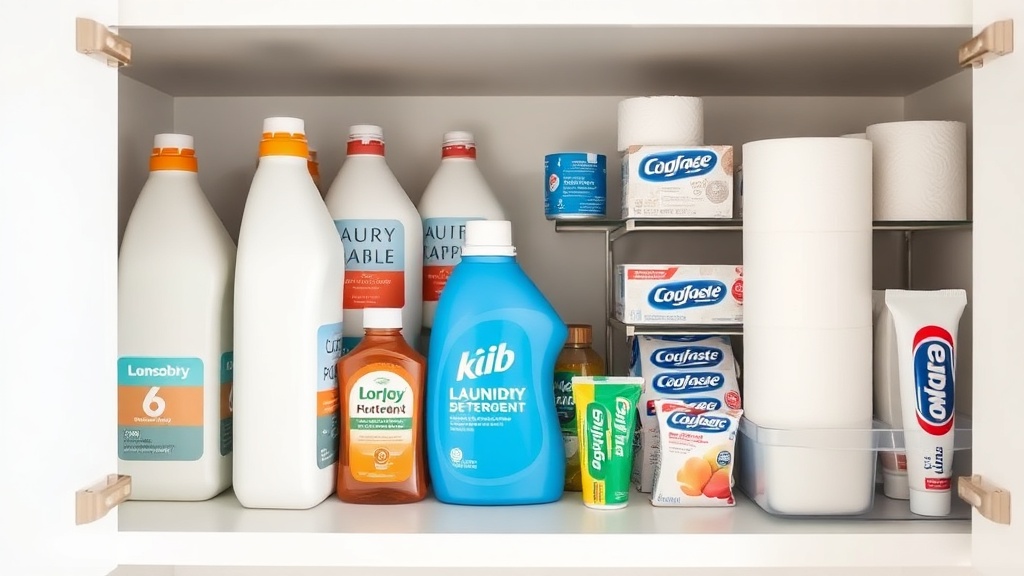
The math, in my experience: if I buy 8 bottles of Tide at 55% off during a Circle Week stack, I don't buy Tide at full price for the next 4 months. My effective monthly cost for laundry detergent drops substantially — and that's before I've touched the other five staples on my list.
The discipline: only stockpile what you actually use. Only buy what fits in your storage. Only go deep on shelf-stable, high-use categories. My personal six: laundry detergent, dish soap, paper towels, shampoo/conditioner, deodorant, kids' toothpaste.
One good Circle Week stack on those six categories typically costs me $120–$140 out of pocket and saves me a meaningful chunk versus buying as-needed at regular prices. Across a whole year, consistently working those championship events adds up to real money — from six boring household categories.
Lesson 5: Find Your Lane — The Two Apps That Actually Pay Out
I've tested a lot of cashback apps over the years. Two I keep coming back to:
Ibotta — Strong for grocery stores and major retailers. The "any brand" offers — often $0.25–$0.50 on produce or dairy — add up fast if you're shopping weekly. Referral bonuses when you bring in family members are real money, not theoretical money. (Check their current store list and cashback flow in the app — they update integrations regularly.)
Fetch Rewards — Slower earnings than Ibotta but you're scanning every receipt anyway, and it catches products Ibotta misses. Gift card redemptions are the sweet spot — savings on Amazon gift cards through Fetch can stack effectively with Prime discounts.
What I dropped: apps that require too many steps to activate before purchase and only work at a narrow list of stores. Too much friction. Cashback has to fit into real life or it doesn't happen.
The IWD Angle I Actually Mean
International Women's Day is March 8.
For me, what matters about this day isn't a theme or a hashtag. It's the reminder that financial independence isn't a destination you reach once you have a better job or a bigger paycheck. It's a practice — a systematic approach to savings that works for real women with real budgets. A set of reps you put in on a Wednesday when there's nothing exciting about it.
The women I know who've built real financial breathing room — emergency funds, paid-off credit cards, retirement contributions actually happening — almost all have one thing in common. They got systematic about the small stuff. Not because the small stuff makes you rich overnight, but because building the habit of paying attention to where money goes transfers to every financial decision you make.
I started Woman Freebies when I was pregnant and genuinely scared about money. The couponing wasn't about clipping paper and feeling thrifty. It was about learning that I had more control than I thought. That every transaction was a choice. That the discipline I'd spent years building in the pool translated — one Ibotta cashback hit at a time — into a completely different relationship with my finances.
That's the empowerment. Not the savings themselves. The agency.
Your Action Plan for Right Now
Target Circle Week typically lands in late March — keep an eye on the Target app for exact dates. Here's how to be ready:
- Download Target's app and create a free Circle account if you don't have one
- Download Ibotta — browse their current offers and explore how they work with your regular stores
- Audit your household staples — what are you running low on? What do you reliably use every month?
- Do one practice stack this week — small purchase at Walgreens or CVS, use all four layers, screenshot the receipt. Feel how it works before the championship events hit
The prep work is right now.
Go run your numbers.
Jessica Martinez runs Woman Freebies from Austin, TX, where she remains mildly competitive about everything.
